
Some interesting facts about colour

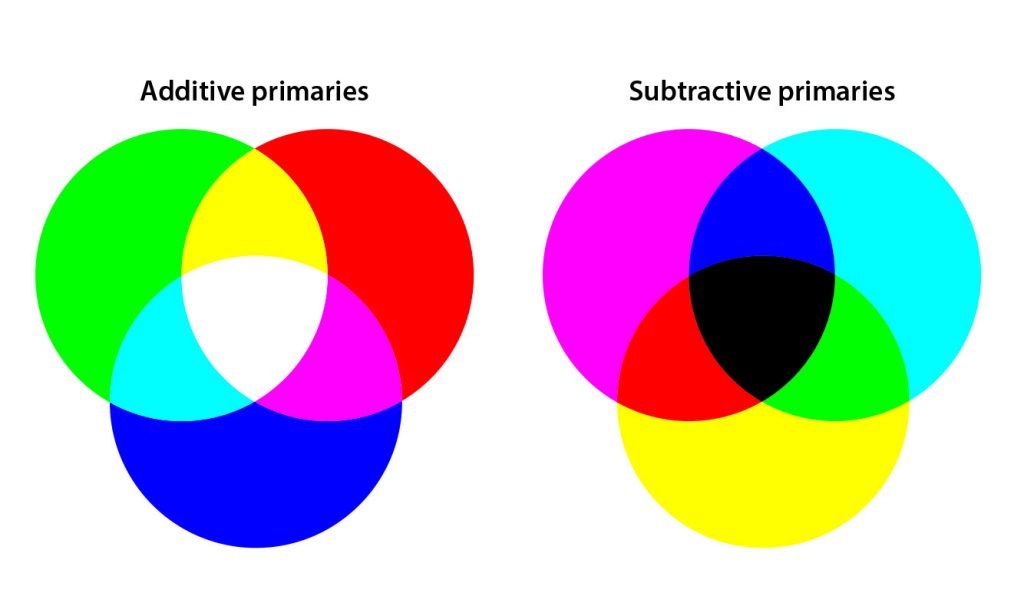
There are in fact two sets of primary colours, additive and subtractive.
Additive primaries (Red, Green and Blue) are those obtained by emitted light. These three colours combine to produce white light, and combinations of these colours can produce millions of other colours. Additive primaries (RGB colours) are what we use in digital situations; computer monitors, phones and iPads etc. The second set are the Subtractive primaries associated with the subtraction of light; Cyan, Magenta, and Yellow. These three colours combine to produce black. Subtractive primaries are what we use for printed material and combinations of these three colours can create many other colours in ‘CMYK’ (Cyan, Magenta, Yellow and Black) printing. This is the world that we in the 2D design studio mainly inhabit, whereas our 3D artists would be more familiar with ‘RGB’ colours. Because of the nature of how these colours are created, there can be difficulties in matching RGB colours to CMYK ones, as colours can seem much brighter ‘on screen’ than in printed executions.
That’s the technical stuff covered, but what about how different colours affect us?
In the 1930’s, neuropsychologist Kurt Goldstein experimented with the effects of colour on a person’s subconscious. The experiments showed that colour affects the ability of the body to keep still, with red light disturbing the equilibrium far more than green light. In a further example of just how powerful the effects of colour can be, he found that a blindfolded person will experience physiological reactions under rays of different colours – so even the skin reacts to colour!
The ability of colour to affect mood should not be underestimated. In the United States, pink has been used in jail cells to calm prisoners and research has shown that you can change your mood by the colours you surround yourself with.
It’s worth noting that, of course, colours mean different things in different places around the world. For example, in our Western culture, black is worn at funerals but in China, white is worn. As our responses to colour are influenced by our cultural differences, upbringing and experience, it’s very hard to scientifically prove that colour has a specific effect on our mood and emotions. Our responses to colour are intrinsic to ourselves.
Red and Blue
Red is is an “additive” primary colour. It is energising and stimulating. It excites the emotions, increases the heart rate and stimulates us to take action. Interestingly, men and women see the colour red differently. Researchers from Arizona State University found that there’s a specific gene that allows us to see and interpret the colour red. Because women have two X chromosomes, the extra X gives them more colour variation in the red-orange spectrum. Menonly have one X chromosome, so where women can see crimson, maroon, cardinal, ruby, and scarlet, menmight only be able to see light, medium, and dark red. Scientist speculate that this difference in colour shade perception in the sexes goes back to our hunter gatherer origins. It would be important for females to differentiate between subtle colour shades when collecting different berries and fruits, whereas men were equipped with vision that better helped them catch and kill moving prey. This might also explain why more men than women are colourblind.
When deepened to burgundy, red is more authoritative, refined and elegant. On the other hand, lighten to pink or rose colour it is youthful, delicate and gentle.
The colour red can also stimulate the appetite, often being used in restaurants for this purpose. In China red is the colour of good luck, and in India it symbolises purity and brides will use it in their wedding gowns (it also stands for prosperity and fertility).
Red and blue were pitched against each other in a 1992 study into which was best to use in a shopping environment. Blue won – more positive retail outcomes and a stronger inclination to shop and browse occurred in blue rather than red environments. Maybe that was because blue was shown to be the most favoured colour in the world in a series of surveys covering 10 countries across four continents. 33 per cent of Britons surveyed said it was their favourite colour.
Blue, the colour of the sky and oceans, is universally perceived as cool and cleansing. Darker blues infer authority and stability which is why they are often used for corporate colours. Paler and greeny-blues suggest more serene qualities, and are associated with spirituality and mysticism.
In 2000, the city of Glasgow introduced blue street lights and unexpectedly saw a decrease in crime. Another city, Nara in Japan, followed suit and also saw a decrease in crime. Some have suggested that the blue suggested a police presence, except that in Japan the police use red lights.
Purple – the colour of kings
Purple is a colour mid way between red and blue. It is associated with royalty, magic and mystery. In ancient times purple dye was made from a sea snail commonly called the “Spiny dye-murex”. The dye “Tyrian purple” was produced from a secretion the snail produces which turns into a lasting dye when exposed to the air. Because Tyrian purple was so hard to make, it became much sought after and the colour of kings, nobles, priests and magistrates all around the mediterranean.
Purple cloth was also rare in the Middle Ages. Those who dyed blue fabric and red fabric were members of different guilds, and were forbidden to dye any other colours than those of their own guild.
Go green
The colour of Nature, green is associated with life, growth, safety, freshness and the environment. Night vision goggles use green because the eye is most sensitive to green light wavelengths, allowing for greater differentiation of objects in the picture.
Green has also been shown in a certain study to increase concentration. The study, published in the Journal of Environmental Psychology, involved 150 students pressing numbers repeatedly flashed on a computer screen, unless it was the number three. Midway through the task, they had a 40-second break when half looked at the green roof and the rest at the concrete one. The first group made significantly less errors and showed superior concentration on the rest of the task compared to the others. So, having a lush green meadow as a computer desktop background may be a smart and productive move!
Green could also be the choice of decoration for a restful room. Because the eye focuses the colour green directly on the retina, it is said to be less strenuous on your eye muscles. However, a factory in the United States changed the colour of the bathrooms to an unpleasant green and saw production increase by 8%. Also, a shade of green is Pantone colour of the year for 2017!
Yellow and orange
Yellow reflects more light and is the colour that the eye processes first. Interestingly, whilst in America yellow is associated with cowardice, in Japan it is the colour of courage. We associate it with happiness, sunshine, spring and joy. But yellow has a dark side. We use it as a colour of caution, physical illness and sources of yellow pigments are toxic metals – cadmium, lead and chrome.
Orange is the only colour of the spectrum whose name was taken from an object – the orange fruit of course! Orange is a scared colour in Hinduism and is worn by Hindu monks. In contrast, it is used for prison uniforms in the US. In Imperial China, yellow was considered the most beautiful and prestigious colour and was the Emperor’s colour.
Brown and Neutral colours
Brown is the colour of the earth, so has associations with the natural world and the organic. It also suggests the security of the home and can make us calm. It can have negative associations with dirt and grime, but it’s wholesome appeal can be summed up by thinking of freshly baked, warm brown bread. Neutral colours like fawn and grey remind us of wood and stone and therefore look natural and solid.
Black and white
In the Western world, white is associated with goodness, purity, cleanliness and simplicity. Black on the other hand is associated with death and mourning. It’s conservative and serious but also sexy, sophisticated and elegant – think of going to an exclusive black tie event in a black stretch limousine!
Colour defines our world and has been around us for as long as we’ve existed but we are now only beginning to understand the subtleties of the influences of colour on our mood and emotions, and how we can use this influence for positive good. It’s crucial for businesses to understand how the colours they choose and use might affect the perceptions their customers have of them. A firm of solicitors might be very excited about their new pink and purple colour scheme without realising that the way it has been used, along with some flowing script typography makes them look like a beauty salon. But, they would get points for being adventurous – too often business will play it safe with colour. Brands that use colour boldly and confidently are often more memorable and therefore successful.
Leave a Reply